
Hello hello, welcome to supercritical.
supercritical: an adjective used across multiple scientific disciplines to describe a state, substance, or system that has exceeded a specific, well-defined critical threshold or point
I’m Ashish, I started this series to create a focused exploration around a thesis I’ve been converging on in recent months:
Many systems are comprised of different subconstituents, like generation of knowledge, dissemination, validation, prestige, and so on.
When an individual subconstituent starts to accelerate faster than others, i.e. it goes supercritical while others remain the same, progress in the system overall starts to stall.
Specifically, progress, instead of increasing linearly, exponentially or even saturating, might resemble a sawtooth shape, with ups and downs as individuals within the system try to react and manage it, applying bandaids, while failing to grasp the shape of the problem.
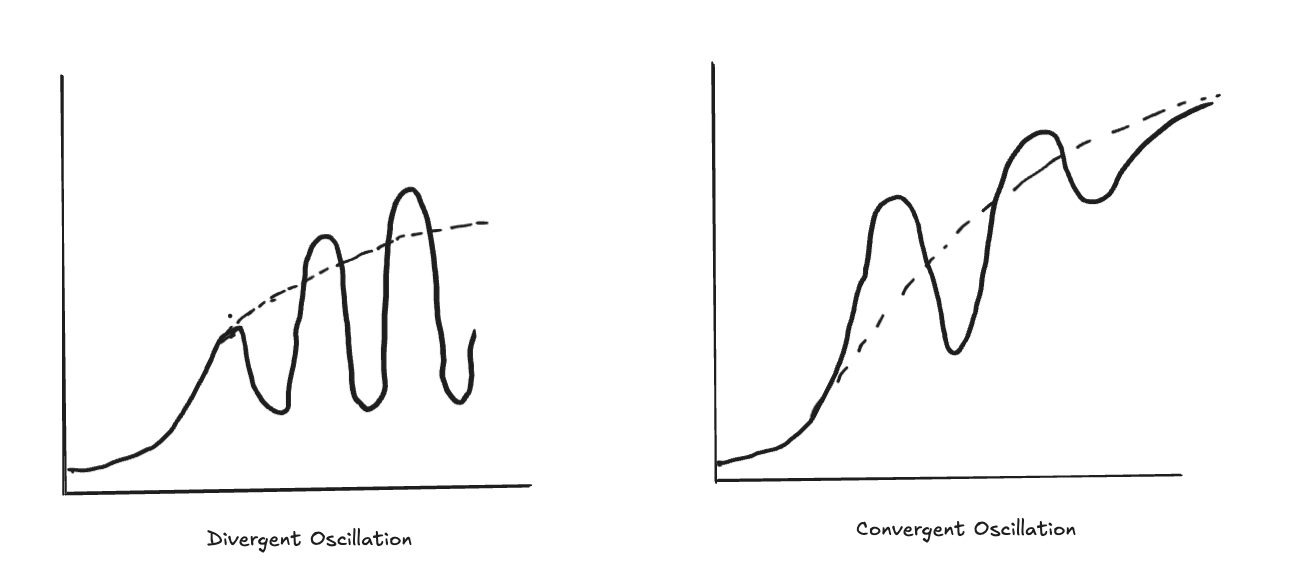
Growth can come with two forms of oscillation — divergent and convergent. In both cases, you’ll experience growth, but the ride can get unnecessarily bumpy. Adapted from Little Science, Big Science by Derek J. de Solla Price1.
What’s to be done? You either try to clamp the part with runaway growth (i.e. abundant generation), or you find a way to improve the rest so the overall system can continue to hum along.
There’s plenty of historical precedent where we’ve figured out how to navigate this successfully (think of Oldenburg, who turned his mailbag into the first scientific journal), so I want to take a 21st century lens to this age old problem.
Metascience May Offer a Blueprint
Many domains are experiencing this, but I intentionally want to start with the scientific enterprise. A lot has been written about this by others, but I wanted to focus on it for a few reasons:
-
Our exploration is going to be equal parts problem diagnosis and solution imagination, specifically around technological capabilities and institutional design for better coordination, grounded in my first and second-hand experiences within science.
-
It’s incredibly pressing and one of the highest leverage areas for intervention
-
I’ve written a bit about AI in science elsewhere, and have worked on the tooling side of this space (both for search & discovery, and innovation) for the better part of my career2.
-
Many of the problems we see in this area are structurally similar (though not necessarily the same) to other areas. This isomorphic nature makes it interesting to examine because it offers lessons that generalize out (and similarly, ideas from elsewhere might prove incredibly useful here).
-
There’s a lot of attention on AI in Science in the “autonomous scientist” sense, but I think a broader view of AI in Science reveals a new class of contextualization and coordination problems that we really ought to be able to get ahead of.
As of writing this, I think that any system of science should enable the following things:
-
Generation: of knowledge, so the curious mind can explore, make discoveries, and report on it.
-
Validation: so others know whether reported findings are to be trusted, and whether individuals themselves and their labs are to be trusted (which itself is foundational to enable collaboration).
-
Dissemination: of validated information, to whomever needs it, when they need it, to avoid duplicative work.
-
Credit (and Prestige): ensure that individuals and teams are properly rewarded for what they found, and their contributions. As we’ll see, this has gotten in the way of previous reformation attempts.
-
Contextualization: enable others (peers, funders, etc.) to understand why they ought to care about something. We do this somewhat through abstracts, and scientific communication in general, but it’s not as effective as it could be (today, we have a chance to enable contextualization on read instead of on write).
-
Archival: how might this information persist for decades or centuries? Should there ever be an expiration date? Does everything need to be persisted uniformly, or can different things be lost over time?
Growth in scientific knowledge production (as evidenced by increasing publication counts, new journals being formed, etc.) has been exponential as it transitioned from a world with a handful of gentleman scholars to large scale industrial science post World War II.
Now, with emerging capabilities (enabled by AI, cloud labs, co-scientists and more), that trend appears to be accelerating. But, as Price points out, it’s important to distinguish true exponential curves from early logistic curves which naturally flatten out due to system level constraints1.
Indeed, validated generation is not increasing at the same rate (no, peer review is insufficient) because we don’t have the same way to report on the underlying traces that led to those results yet.
My hunch is that getting progress back on a steady growth path will demand a set of new technological and coordination primitives, and possibly experiments in institutional design itself.
You even see some of this happening today, with AI in math showing really interesting patterns of networked collaboration, and to some degree in drug discovery and materials science, where adopting new tech is driven by market level incentives3.
This pattern of patchwork progress will likely continue as groups tinker and figure out what works and what doesn’t within their respective constraints, but we’ll need a neutral party thinking about coordination across the ecosystem, paying attention to what works and what doesn’t, and ideally one that plays a meta-level role in designing experiments to stress test these different solutions4.
But that’s enough of that. Here’s a teaser of some of the essays that are coming your way over the next few weeks:
-
Coordination Tech in Science: Letters, Journals, and What Comes Next: An exploration of how the Journal, and publishers, bundled some of these key capabilities, and what it’d look like to unbundle them.
-
Virtual Witnessing, Again: Imagining new ways to scalably enable trust in reported findings.
-
The Invisible College: Exploring the social dynamics of frontier science, how reputation systems work today and in the future
-
First, or Forgotten?: Is the scientist the creative, relentlessly curious mind we sometimes imagine? How does that vary across disciplines, and how has it changed in different generations? What role do credit and prestige play in the drive of the scientist in making discoveries and advancing the frontier?
-
Being a Renaissance Man in the 21st Century: How is someone going to keep up with all their interests in all these different fields when we scale up validated knowledge production?
-
Preserving Which Knowledge?: Approaches we’ve taken for archival and preservation in the past (market structures and more), and how we might apply that here to ensure emerging knowledge is preserved for decades and centuries.
-
The State of 22nd Century Science: A historical imagining of the future, this is a report from the year 2222 about how science worked in the 22nd century, by a future historian of science.
-
...and more!
More soon,
Ashish