
What does a researcher fantasize about when their submission gets rejected from prestigious journals like Nature? Why, getting a Nobel Prize for that work, fame, glory, and the enviable chance to say "I told you so". This happens more often than you'd think!
In 2005, Katalin Karikó and Drew Weissman submitted the modified-mRNA paper that would eventually underwrite the COVID vaccines, and Nature desk-rejected it inside twenty-four hours; the two of them shared the prize in 20231. Kary Mullis fared no better with the foundational methods paper for PCR, which Nature and Science both passed over before it found a home in Methods in Enzymology, and he collected his Nobel in 19932.
Enrico Fermi's theory of beta decay was reportedly turned away by Nature in 1934 as "too remote from reality," a judgment the 1938 prize quietly reversed3. And Hans Krebs, having worked out the citric-acid cycle, watched Nature reject it in 1937 for what was ostensibly a backlog, so he published in Enzymologia and was awarded the prize in 19534.
You can explain these away — a paper failed to make its importance legible, an overwhelmed editor was clearing a queue, and so on — but the pattern underneath is hard to miss: venue and value are not synonymous.
That makes for an awkward question in a world where anyone can post a preprint online for free: why does everyone still clamor to land their work in "top-tier journals"? It's not distribution, which the internet handles and arguably preprints do better by being free and easy to search. It could be peer review functioning as a quality hurdle, except that hurdle typically runs on unpaid labor and carries its own well-documented problems.
What journals actually sell is subtle, and quite difficult to replace: the belief that your work counts.
The Journal as a Coasean Firm
The journal, since its inception, has quietly done four things at once.
- It registers who got somewhere first, so an investigator gets credit and has a reason to keep going.
- Then comes certification: it vouches that the work is sound, as determined by their peers, to help future readers separate signal from noise and focus their attention.
- The journal shares publications outward into the field to ensure others discover the work.
- The journal archives it, so future scientists can provably access the same work and have some confidence that it is the original, untampered document.
Before print, these four jobs ran through individuals. In the 1600s, scientific correspondence was held together by a group of well-connected men who sat at the center of the web and passed news along.
Henry Oldenburg, the first secretary of The Royal Society, spent his days taking in work (often in other languages), copying it out, dating each item to settle who had gotten there first, vouching for the sender, and forwarding it to whoever might care5. Marin Mersenne played the same part in Paris, and when he died in 1648 the network he had been holding together largely had to be rebuilt from scratch6.
In 1665, Philosophical Transactions took what Oldenburg was doing by candlelight and set it inside an institution, so that the four jobs no longer depended on one man staying alive and answering his mail7.
Why not leave all of these different functions to the open market? Ronald Coase offers an economic perspective that sheds some light. Using the market carries its own costs: you have to find the right party, negotiate terms, and verify that they actually delivered. When these costs are sufficiently high, it becomes cheaper to bring those jobs under one roof8.
Printing, postage, vetting a stranger's claims were all expensive in the 1600s, so a journal that would weld registration, certification, dissemination, and archival into a single act of publishing was the simpler arrangement.
Thus the firm of scholarly communication emerged, and over 300 years later, is still around. For centuries, scarcity kept the bundle more efficient.
New Fields, New Journals
Journals are, in essence, a convenient coordination technology, and like any tool, one can be built fresh when what already exists fails to meet the task.
When scientists in a field decide there isn't an adequate outlet for their area of interest, they can band together and start a new journal to use as a container for shared context and coordination. They'll need to determine its scope, ensure it doesn't conflict with what exists, find editors, ideally well-known active researchers who can help with its brand and readership and encourage others to publish in this venue, and more. Over time, publications accrue and the relative importance of that journal grows.
Benjamin Lewin did exactly this in 1974, founding Cell for the young field of molecular and cell biology, editing it hands-on, issue by issue, and within about a decade it had grown to rival Nature and Science9.
I want to emphasize the social dynamics here because it's often overlooked when we think about the transition from little science to big science. It's easy to imagine science as a monolith, when in reality it has different pockets of communities, some self-organizing, some bouncing back into the broader field. This is clear when you consider the rate of journal formation over the years.
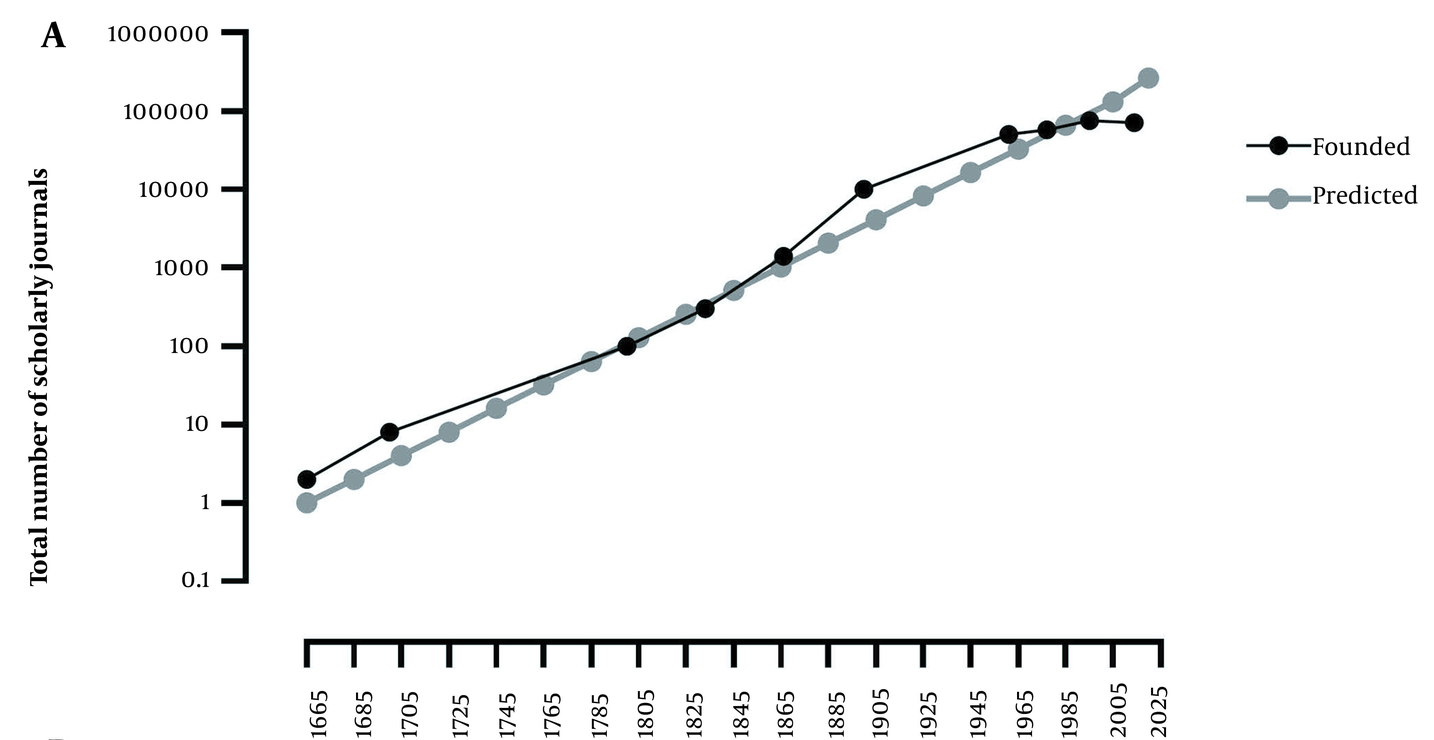
Increase in scholarly journals from their birth. The grey line is the number predicted by Derek J. de Solla Price, while black is the actual estimate10. Not every founded journal is still active.
These journals start with little, but over time, the ones that survive accrue prestige as its community and editors publish, review, and disseminate. Once built, prestige becomes the journal's asset, and as we'll see, is often owned by a commercial publisher, not the individuals who helped build it.
Prestige Defense, and the Impact Factor
Indeed, post-internet, many of the costs associated with dissemination and registration decreased drastically. Preprint servers stamp priority, DOIs and repositories help with distribution and storage, and none of it needs a journal to function11. Certification however did not get cheaper; if anything it became more expensive.
Let's look at Elsevier. In an ordinary competitive business, when costs fall the price falls with them, because rivals undercut one another and pass the savings along to the buyer, and margins thin out over time. The internet drove the cost of copying and shipping a paper to almost nothing, so if Elsevier were mainly selling the service of producing and distributing papers, its margin should have followed those costs down.
Instead, it barely moved. Elsevier's science arm ran an operating margin around 36% in 2010, and its parent company reported roughly 38% for its scientific-publishing division in both 2023 and 20241213 — roughly fifteen years across which the marginal cost of the underlying work collapsed while the margin held flat and even drifted upward.
A margin that refuses to fall as costs fall means buyers are paying for something they cannot get anywhere else, and will pay a premium for regardless of what it costs to make. Here, that something is the prestige of its journals, the shared belief that publishing there means your work counts (and in this case, counts more than those published elsewhere).
If what these publishers sold was really cheap-to-produce distribution, the internet should have let new entrants undercut them and pull papers away from the incumbents; instead the biggest publishers grew, and by 2013 the top five accounted for more than half of all papers14.
This consolidation wasn't a passive byproduct of digital scale, but actively engineered through market manipulation. Publishers leveraged their crown-jewel titles to force universities into opaque, all-or-nothing subscription packages known as "Big Deals"15. By tying high-prestige must-haves to hundreds of low-tier journals, commercial publishers monopolized university library budgets, effectively starving independent, newly formed journals of capital before they could even begin to accrue their own prestige.
The belief that a venue counts gets minted into a number — the Journal Impact Factor, which Eugene Garfield built in the 1950s and 60s as a tool to help librarians decide which subscriptions to buy. Over time, it drifted into use as a proxy for the quality of individual scientists and papers16. The h-index followed, and now granting agencies, hiring committees, and tenure boards run on both17.
Eugene Garfield originally imagined a future where "intelligent machines" might read documents and create richer annotations, offering more depth into how quality is assessed18. The impact factor and other metrics were the best available tools at the time, and were perverted into creating a prestige moat for publishers through the career incentive grip they wield with universities.
This turned into a spectacle in 2023 when the entire editorial board of NeuroImage — more than forty editors — resigned after Elsevier refused to bring its open-access fee down, and a month later rebuilt themselves as the nonprofit Imaging Neuroscience at MIT Press19. The community walked out the door and took its judgment, its labor, and its trust along with it. Elsevier kept the title NeuroImage and, more to the point, kept its impact factor. The people who had earned the prestige were free to leave; the prestige stayed with the brand. Evidently, the brand was the asset and the people had only been renting it their reputations.
I don't want to imply that publishers do nothing. They coordinate referees, manage submissions and versioning, copyedit and typeset, mint the metadata that makes work findable, commit to keeping the archive of the version of record alive, carry the burden of storing the data associated with research, and play a key role in scholarly communication. But in many instances, the primary obstacle to reform has been the wall that publishers and universities built around prestige.
Why bother reforming this at all?
Two reasons:
- The status quo system disproportionately impacts early career researchers.
- In this setup, only publishers can actually create change (because they control the credit system), but their business models often make it difficult to be the source of change, so things stall.
Regressive Tax on Early Career Researchers
Established researchers playing at the frontier get most of their real coordination from outside the journal system entirely — from email and lab meetings and the fast informal exchange amongst peers. Formal publication, here, is almost a tax paid after the fact. Credit still matters since you want recognition for your findings, but once the reputation flywheel is going, they don't depend on the public record as much to build their collaborator network.
The early career scientist, however, has no informal standing to trade on, so they depend on the legible, published record to build currency, and they cannot route around the slow, incumbent-controlled venue the way a senior scientist can: a months-long peer-review cycle is a mild inconvenience to someone already trusted, but a serious cost to someone still trying to become legible in the first place. In that sense, the bundle is a regressive tax falling hardest on those with the least accumulated credit.
I'll unpack the dynamics of credit and the invisible college in a later essay, but the main point I want to make here is that the whole climb from newcomer to established scientist is, in the end, the process of earning entry into the invisible college where the real collaboration happens informally. The public system behaves like a tollgate between the collaborator bubbles at the frontier and the more populated, crowded center.
Navigating Reform: Completing the Unbundling
Attempts to break the journal bundle are not new. Between 1961 and 1967, long before the internet, the NIH ran the Information Exchange Groups (IEGs). This preprint network circulated unpublished papers by mail among a membership that grew past 3,600 scientists. It was essentially arXiv three decades early.
It failed not because of a technical flaw but because journal editors, seeing the threat to their position, agreed to refuse publication to anything that had been circulated through it. Strangled of academic credit, the network's value went away20.
Today's preprint servers have succeeded where the IEGs failed, structurally shifting us from a rigid "Review, then Publish" (RP) model to a fluid Publish, then Review, then Curate (PRC) sequence21.
But this process is far from finished. Most modern attempts stall on the stickiest part of the journal: prestige. We have to recognize that prestige is really a fused proxy for two separate judgements:
- Trust (soundness): The baseline verification that the methodology is valid and the data isn't fabricated, etc. (the stamp of approval, bestowed upon a paper after peer review)
- Significance (importance): An editorial guess as to whether the work matters to the broader field, which is impacted by two sets of contextualization problems:
- The first on the submission side, which helps an editor decide if a paper is important (see Nobel rejection examples earlier)
- The second on the post-submission side, which helps others determine the "value" or importance of the work in different contexts.
Both of these are ripe for disruption through new technological primitives.
Peer review can still exist (depending on the norms that a community of scientists set in their field), but it ought to be augmented, perhaps by capturing decision traces and manifests during the research process. I unpack this more in my next essay Virtual Witnessing, Again.
Determining the importance of any work can be enabled by the "intelligent machines" that Eugene Garfield imagined, ones which enable contextualization of information on read instead of on write.
Today, we require scientists to write abstracts and maybe write blogs explaining why their work is important to different audiences. Tomorrow, they might just report on their findings, and our intelligent machines will help us determine their importance, rooted in an awareness of what's important to us, situated within the broader field.
The internet unbundled aspects of the journal by streamlining distribution, but it left our institutional infrastructure untouched. By developing and deploying new coordination technologies — from immutable research provenance protocols to dynamic "on-read" evaluation tools that enable new quantitative and qualitative ways to determine impact and importance, we can finally decouple trust from prestige. Provide trust and significance directly, and a venue's prestige doesn't have much to stand on.
While necessary, technological changes are insufficient. What we see in the lifecycle and dynamics of journal and society formation, growth, and persistence or death is a reflection of the social dynamics of the scientists and communities operating within. Any new system has to operate from an understanding of this behavior to actually build an adequate theory of change.
Personally, I think this is a really exciting time to think about shaping solutions to these problems. At a time when our ability to generate scientific data is supercritical, we need our collaboration and coordination infrastructure to catch up so that scientists can get to and advance the endless frontier.
More soon,
Ashish
-
Karikó & Weissman — modified-mRNA paper desk-rejected by Nature (2005); Nobel 2023. source ↩
-
Kary Mullis — PCR; foundational methods paper passed over by Nature/Science, published in Methods in Enzymology; Nobel 1993. source ↩
-
Enrico Fermi — beta-decay theory turned away by Nature (1934) as "too remote from reality"; Nobel 1938. source ↩
-
Hans Krebs — citric-acid-cycle paper rejected by Nature (1937), published in Enzymologia; Nobel 1953. source ↩
-
Correspondence of Henry Oldenburg, Early Modern Letters Online (Bodleian). source ↩
-
Marin Mersenne — Paris correspondence hub; network dispersed on his death (1648). source ↩
-
Royal Society, "History of Philosophical Transactions" (1665); four-function framing via Roosendaal & Geurts (1997). source ↩
-
Coase, R. H. (1937), "The Nature of the Firm," Economica. source ↩
-
Cell (journal) / Benjamin Lewin — founded 1974 for molecular & cell biology; grew to rival Nature and Science. source ↩
-
"Scientific Publishing in Biomedicine: A Brief History of Scientific Journals" (PMC, 2023) — journal counts grew ~3.46%/yr (doubling ~every 20 years), driven by specialization; grey-vs-black chart data (Price's prediction vs. actual). source ↩
-
Priem, J. & Hemminger, B. (2012), "Decoupling the scholarly journal," Frontiers in Computational Neuroscience. source ↩
-
Research Professional News (2024), "Elsevier parent reports 10% hike in profits for 2023" — RELX STM operating margin ~38% (2023), 38.4% (2024). source ↩
-
Buranyi, S. (2017), "Is the staggeringly profitable business of scientific publishing bad for science?" The Guardian — Elsevier ~36% (2010), >40% (2012–13). source ↩
-
Larivière, Haustein & Mongeon (2015), "The Oligopoly of Academic Publishers in the Digital Era," PLOS ONE — top-5 publishers >50% of papers by 2013. source ↩
-
Bergstrom, Courant, McAfee & Williams (2014), "Evaluating big deal journal bundles," PNAS — pried open secret "Big Deal" bundle contract prices. source ↩
-
"Impact factor" — Garfield's librarian tool (1950s–60s), later misused as a quality proxy. source ↩
-
"h-index" — Hirsch (2005); used by granting agencies, hiring and tenure committees. source ↩
-
Eugene Garfield, Essays of an Information Scientist — his vision of machine-assisted reading/annotation of the literature. source ↩
-
STAT News (2024), "Why I left the editorial board of NeuroImage — and helped start something new" — 40+ editors resign (2023), rebuild as nonprofit Imaging Neuroscience; Elsevier keeps title + impact factor. source ↩
-
Cobb, M. (2017), "The prehistory of biology preprints," PLOS Biology — NIH Information Exchange Groups (1961–67), killed when editors refused credit. source ↩
-
Stern, B. M. & O'Shea, E. K. (2019), "A proposal for the future of scientific publishing in the life sciences," PLOS Biology — the Publish–Review–Curate (PRC) model. source ↩